
A big button phone for care homes is a simple, high-contrast telephone that residents can actually see, press and hear. For procurement teams, importers and telecom brands, the decision is not just “large keys”: it is keypad design, receive and ringer volume, hearing-aid compatibility, one-touch or SOS calling, and whether the set sits on a bedside table, a wall bracket or a PABX extension.
Start with the rooms you are equipping, then specify the features those rooms need, and test a sample in the real lighting and noise of a resident room. A big-button set is not the same thing as a fully amplified telephone, and an SOS key is not a substitute for a nurse-call or monitored telecare system.
Key takeaways
- Specify a big button phone for care homes by room type: resident rooms usually need a corded, wall-mountable set that stays in place; common rooms may need more one-touch memories or a speakerphone.
- Look past key size. High contrast, tactile markers, optional Braille, a loud ringer and a visual call indicator matter as much as an oversized keypad.
- Treat “amplified” as a measured claim. The SKH-410PRO lists a 20+ dB volume boost for the handset and speaker. Hearing-aid compatibility is a separate requirement; several CFH models list it as optional, so state it in the RFQ when the destination market requires it.
- One-touch memories, photo or figure buttons, and SOS loop dialing help residents reach family or staff. Confirm how many numbers can be stored and whether a remote or pendant is needed. Published MOQ for these OEM/ODM models is 3,000 pcs.
What a big button phone for care homes needs to do
Care-home and assisted-living telephones serve people who may have reduced vision, reduced dexterity, hearing loss, or difficulty remembering a number sequence — and they also have to work for staff. AbilityNet’s guidance on telephones and mobile phones is a useful reminder that big keys, amplification, a visual ring indicator and hearing-aid compatibility solve different problems.
Map features to locations before you lock a SKU:
- Resident rooms and bedside tables. A corded, desk- or wall-mountable phone that does not need charging is usually the safer default. Look for a loud ringer, a visual indicator, simple memories and, where required, an SOS function.
- Common rooms and corridors. A speakerphone and more one-touch keys help when several people share a set. Wall mounting keeps the phone visible and off tables.
- Staff or office extensions. PABX compatibility and adjustable flash timing matter more than SOS jewellery. Several CFH big-button models list tone/pulse dialling and flash times of 100, 300, 600 or 1,000 ms.
Cheng Feng Hao’s big button phone range is built for office and residential use, including senior projects, and is offered for OEM and ODM orders. The models below are corded analogue telephones, not SIP desk phones and not 4G fixed wireless phones.
Big buttons, contrast, Braille and picture memories
Oversized keys only help if the digits stay readable in typical room light and if the user can find the next key by touch. Prefer high-contrast number pads, well-spaced buttons and a raised marker on the 5 key. If residents include Braille users, specify Braille-marked keys rather than assuming every big-button set includes them.
On the current CFH listings, the SKH-410PRO has big buttons with Braille as standard. The SKH-405 also lists Braille keys, and the SKH-403 lists them as optional. The SKH-403 is the model to look at for picture memories: it lists three one-touch memories “with figure”, plus ten two-touch memories, so a resident can press a photo of a family member or a carer.
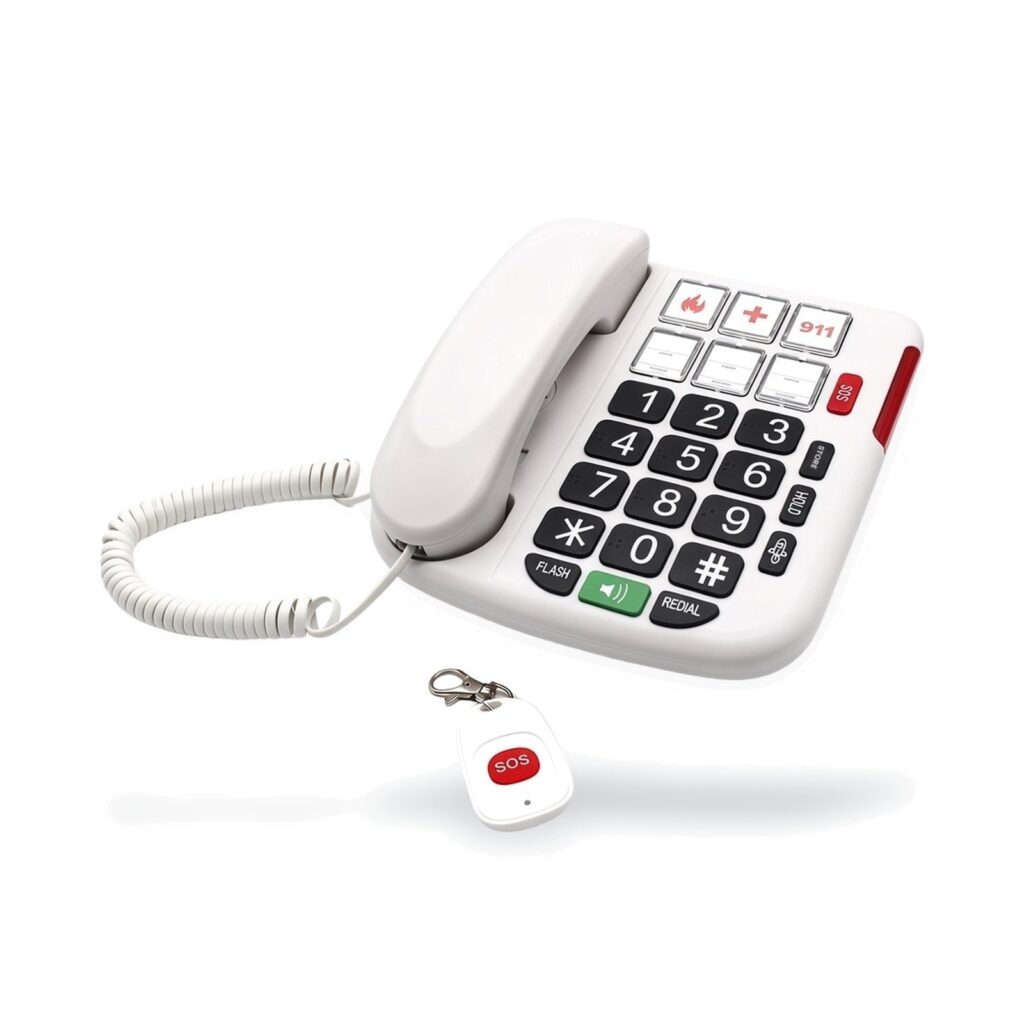
Keep the interface short. One-touch buttons, a clear SOS key and a photo window are usually more useful than a dense menu. If the project also needs the caller’s number on a display, treat that as a separate requirement — see our caller ID phone buying guide — and write it into the specification.
Amplification, ringers and hearing-aid compatibility
An amplified telephone raises the level of the caller’s voice in the earpiece, and often the ringer as well. AbilityNet notes that tone control, a louder ringer and a visual call indicator are separate choices. Do not treat “big button” and “amplified” as interchangeable: many large-key phones only offer a standard high/low handset or speaker control.
Among the current CFH models, the SKH-410PRO is the one that publishes a measured boost: 20+ dB for the handset and speaker, plus a loud ringer, speakerphone and a ringer or message indicator. The SKH-410 lists volume boost and separate handset, speaker and ringer controls, without a published decibel figure. The SKH-395 and SKH-398 list high/low volume adjustment and optional hearing-aid compatibility.
If you sell into the United States, hearing-aid compatibility and volume control are regulated for wireline telephones. The FCC summarises the rules on its hearing aid compatibility page for wireline telephones. 47 CFR 68.316 sets the magnetic-field criteria that let a handset couple to a hearing aid’s telecoil. 47 CFR 68.317 covers volume control: telephones manufactured in or imported for use in the United States on or after 28 February 2020 must provide, at the loudest setting, 18–24 dB conversational gain as measured by ANSI/TIA-4965-2012. Gain above 24 dB is allowed only if it automatically resets to no more than 24 dB after a proper on-hook transition.
Those figures are test requirements, not a label you can assume for every SKU. On several CFH listings, hearing-aid compatibility is marked optional. If a tender requires HAC or a published volume boost, write the test method and the mark into the RFQ and confirm it on a golden sample. Our telephone certifications guide covers CE, FCC, ETL and RoHS for importers.
SOS keys, pendants and one-touch contacts
Safety features are often why a care home specifies a dedicated senior phone. The useful questions are how the alarm is triggered, how many numbers it will try, and whether a resident must reach the base to press SOS.
The SKH-410PRO lists a wristband SOS remote with a range of over 20 m, loop dialling of up to six SOS numbers, six one-touch memories and ten two-touch memories. The SKH-410 offers the same six emergency numbers and SOS loop dialling, with an optional SOS pendant. Other models concentrate on memories rather than a remote: the SKH-398 lists nine one-touch memories; the SKH-403 and SKH-405 list three one-touch plus ten two-touch memories.
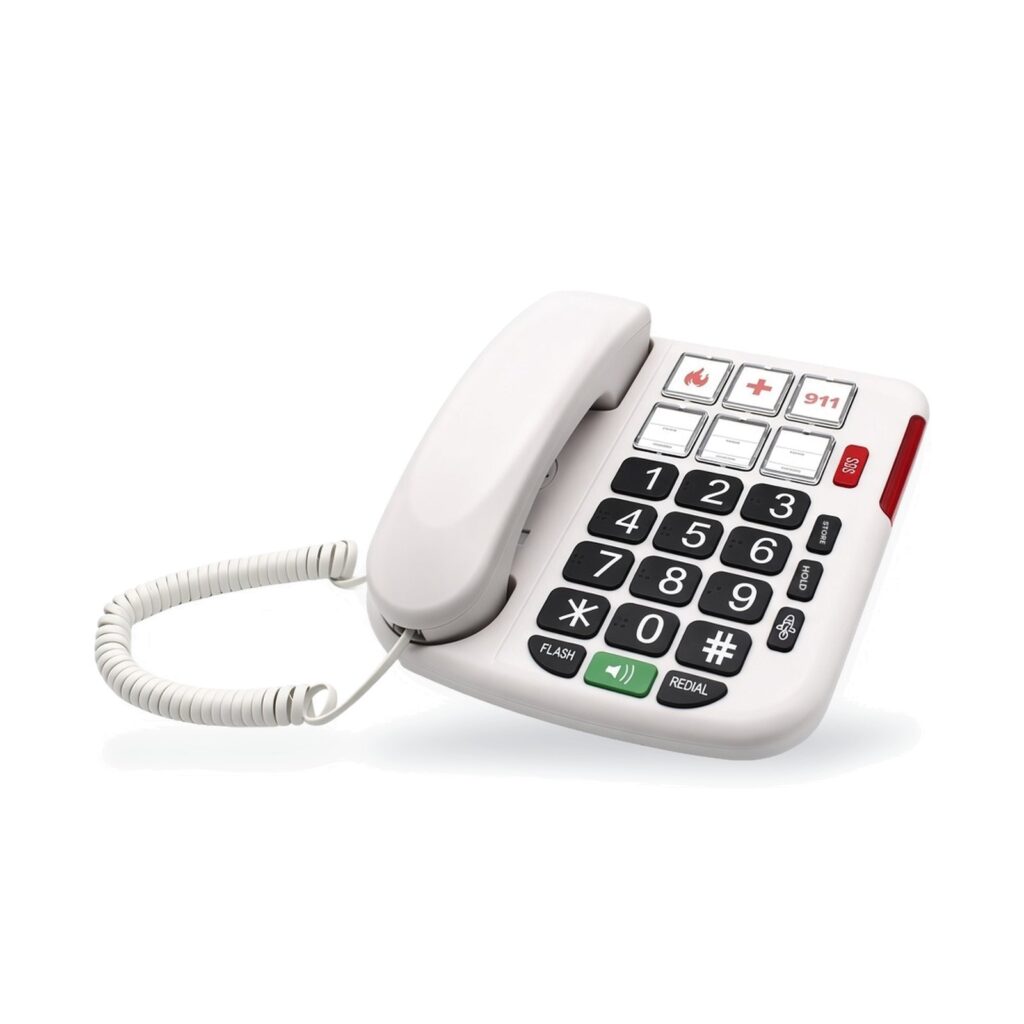
Be precise in the specification and in staff training. An SOS key that loop-dials stored numbers is a telephone feature, not a nurse-call system or a monitored telecare alarm. Program the numbers the home has agreed, label the keys in the local language, and test pendant range on the actual floors and walls of the building.
Corded sets, wall mounting and PABX or digital lines
Most care-home bedside phones are still corded: they do not depend on a charged battery, and a wall-mount bracket keeps the set at a consistent height. Every CFH big-button model in this guide is desk- or wall-mountable.
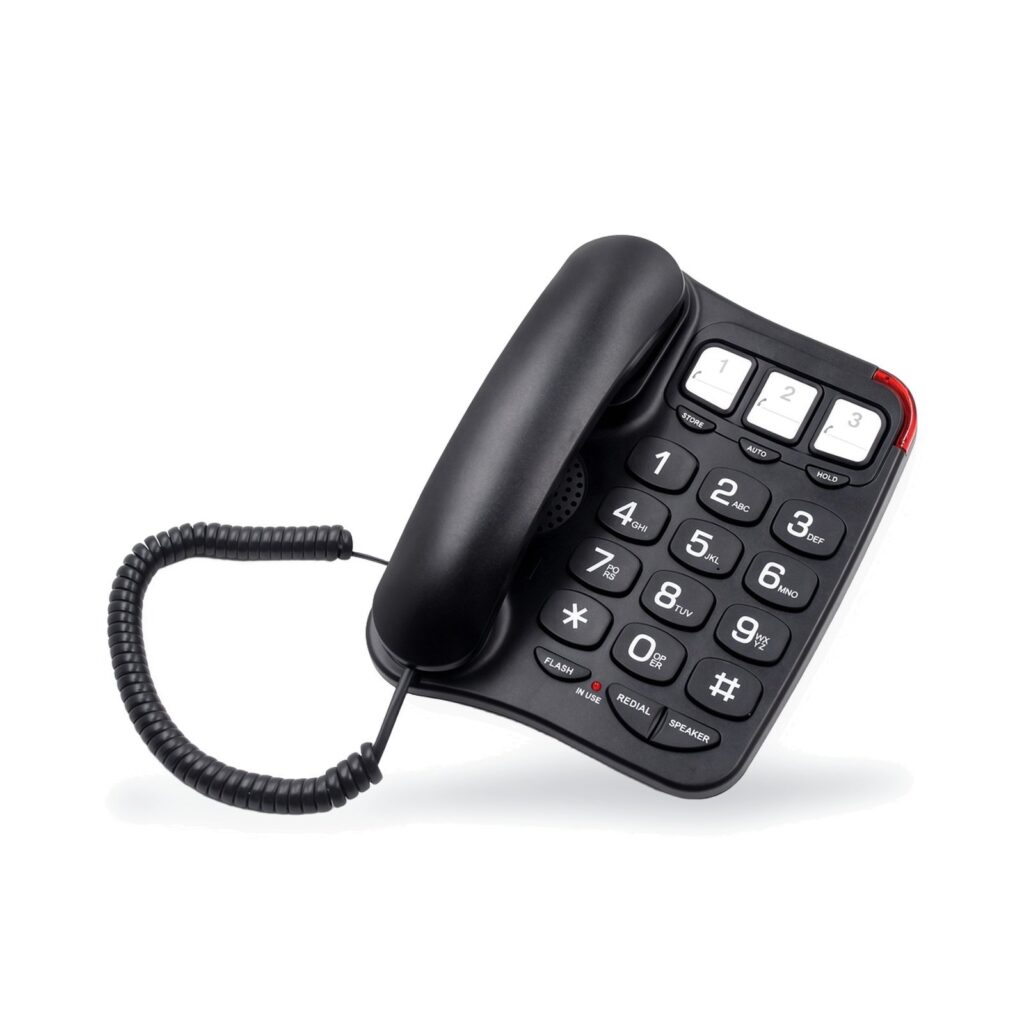
If the phones sit behind a PABX, confirm flash or recall timing and tone/pulse dialling on a sample extension. The SKH-395, SKH-398, SKH-403, SKH-405 and several related models list PABX compatibility and optional flash times of 100, 300, 600 or 1,000 ms.
These are analogue telephones. They need an analogue extension, a router analogue port or an analogue telephone adapter. In markets where the copper PSTN is being retired, discussed in our 4G fixed wireless phone versus landline guide, ask the voice provider how corded phones will connect and what happens to a line-powered alarm during a power cut. A big-button handset will not register as a SIP endpoint; for IP extensions, use a SIP or IP desk phone instead.
Which CFH models fit care-home and assisted-living projects
The table below summarises published listing data for the models most relevant to care-home and assisted-living projects. Confirm optional features on the purchase order.
| Model | Best fit | Keys and memories | Sound and SOS | Mounting |
|---|---|---|---|---|
| SKH-410PRO | Resident rooms needing louder receive audio and a wearable SOS trigger | Braille big buttons; 6 one-touch + 10 two-touch memories | 20+ dB boost; loud ringer; SOS remote over 20 m; 6 SOS numbers, loop dialling | Desktop or wall |
| SKH-410 | Resident rooms needing SOS loop dialling; pendant optional | 6 one-touch and 10 two-touch memories | Volume boost; two-way speakerphone; optional SOS pendant; 6 emergency numbers | Desktop or wall |
| SKH-403 | Residents who recognise a photo or figure better than a number | 3 one-touch with figure; 10 two-touch; Braille optional | Speakerphone; hearing-aid compatibility optional | Desktop or wall |
| SKH-405 | Projects that want Braille keys as standard | Braille keys; 3 one-touch + 10 two-touch memories | Speakerphone optional; hearing-aid compatibility optional | Desktop or wall |
| SKH-398 | Shared phones needing more one-touch contacts and PABX features | 9 one-touch memories; speakerphone | Handset/speaker volume adjustment; HAC optional; music on hold | Desktop or wall |
| SKH-395 / SKH-402 / SKH-3255 | Straightforward big-button PABX extensions | 10 two-touch memories | Speakerphone; hearing-aid compatibility optional | Desktop or wall |
What OEM buyers and procurement teams should specify
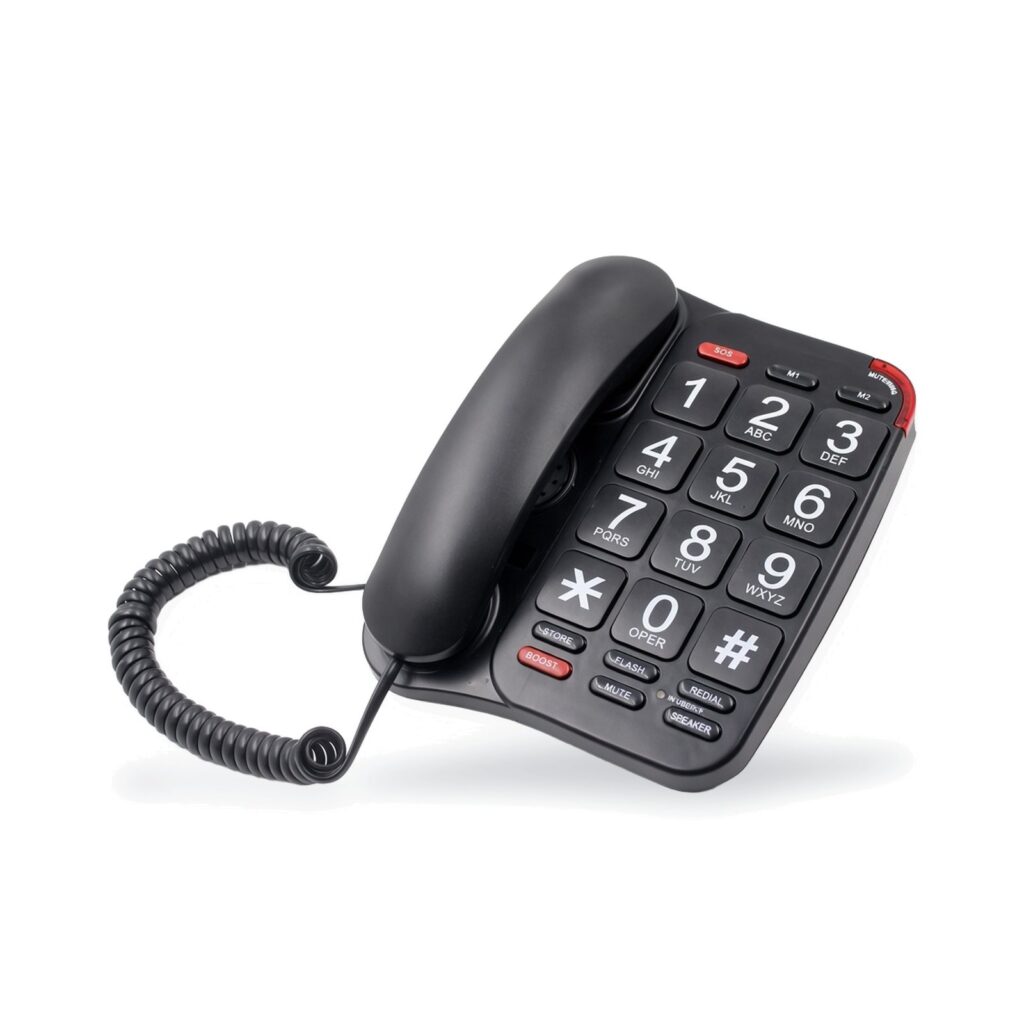
A clear RFQ prevents a rollout from mixing almost-similar SKUs. Name the destination countries, the room types and quantity, and the features that are mandatory.
- Use and environment. Resident room, common room or staff extension; desk or wall mount; colour (white, black or grey are listed on several models).
- Keypad and memories. Contrast, Braille, one-touch or photo buttons, and how many SOS or staff numbers must be stored.
- Audio. Required receive gain, ringer behaviour, visual indicator, and whether hearing-aid compatibility is mandatory.
- Line interface. Analogue extension, flash timing, tone or pulse, and any ATA arrangement after a PSTN change.
- Compliance and branding. Certification marks for each market (see our certifications guide), manual language, logo and packaging. Cheng Feng Hao can customise logo, colours, packaging and language.
Cheng Feng Hao (brand CFH) is a telephone manufacturer founded in 2003, with a factory established in 2010, more than 250 employees, a 30,000 m² factory, annual output of US$10 million, and ISO 9001:2015, ISO 14001:2015, BSCI and ETL. The published MOQ for these models is 3,000 pcs, with OEM and ODM available. The custom process is covered in our OEM vs ODM telephone manufacturing guide. Test a pre-production sample in a real room: contrast, ringer audibility and pendant range are hard to judge from a specification sheet alone.
Frequently asked questions
What is the difference between a big button phone and an amplified telephone?
A big button phone is designed around a large, high-contrast keypad. An amplified telephone raises the caller’s voice, and sometimes the ringer. Many care-home projects need both in one set, but the two features are specified separately. On the current CFH range, the SKH-410PRO publishes a 20+ dB volume boost.
Should a care home choose a corded or a cordless big button phone?
For most resident rooms, a corded, wall-mountable telephone is more reliable because it does not depend on a charged battery and is less likely to be mislaid. Cordless handsets can help in a private apartment, but they add charging and coverage questions. The CFH models in this guide are corded analogue sets.
Are CFH big button phones hearing aid compatible?
Hearing-aid compatibility is listed as optional on several models, including the SKH-395, SKH-398, SKH-403 and SKH-405. If residents use telecoil hearing aids, or if a destination market requires magnetic HAC under rules such as 47 CFR 68.316, state that requirement in the RFQ and confirm it on the sample you approve.
Will these phones still work after a landline or PSTN switch-off?
They are analogue telephones, so they work only if the new service still provides an analogue port — a router phone socket, an analogue telephone adapter or a PABX extension. They will not register as SIP endpoints. Plan the line interface with the voice provider, including backup power if a resident alarm uses the same line.
Is an SOS button a substitute for a nurse-call or telecare system?
No. SOS loop dialling and a wristband or pendant will call the numbers you store. That is useful, but it is not a monitored nurse-call or telecare alarm unless the care home has integrated it that way and tested it. Keep the two systems distinct in the specification and in staff procedures.
What is the minimum order quantity for OEM big button phones?
The published MOQ for the CFH big button models in this guide is 3,000 pcs per model. OEM and ODM are available, including custom logo, colours, packaging and language. Send the destination countries, room types and required features to sales1@skhelc.com.
Request a big button phone quotation
If you are specifying a big button phone for care homes, assisted living or a senior retail range, send the destination countries, room types, required audio and SOS features, and the estimated quantity to sales1@skhelc.com or use the contact form. We will confirm which CFH models fit and reply within 24 hours during office hours.