
If you import telephones, telephone certification is part of the product, not a brochure extra. A corded desk phone, a hotel telephone and a DECT cordless phone follow different legal routes in the EU, the UK and the United States. This article explains what CE, FCC, ETL and RoHS actually mean, who is responsible, and what evidence you should ask a factory to provide before you book a container. It is a practical briefing for importers, not legal advice; always read the current official text or ask a compliance consultant for your HS code and markets.
Key takeaways
- CE (EU), FCC (US) and UK product marking are legal market-access requirements. They are not interchangeable. A CE mark does not authorise US sales, and an FCC ID does not authorise EU sales.
- A cordless or cellular telephone is radio equipment and usually faces a heavier process (EU Radio Equipment Directive; US FCC Certification with an FCC ID) than a purely wired phone.
- ETL is a safety listing from Intertek, an OSHA-recognised Nationally Recognized Testing Laboratory (NRTL). Retailers often ask for it. It does not replace FCC or CE.
- RoHS restricts hazardous substances. Factory ISO 9001 or ISO 14001 certificates, and a BSCI social audit, are useful supplier credentials — they are not product marks.
- Ask for test reports, certificates, a draft declaration of conformity and label artwork at quotation stage. Cheng Feng Hao holds ISO 9001:2015, ISO 14001:2015, BSCI and ETL, and arranges CE, FCC, RoHS and other market tests on request.
Match the rule to the product and the market
| Market | Typical wired (corded) telephone | Typical cordless, DECT or cellular desk phone | Official starting point |
|---|---|---|---|
| European Union | CE under the Low Voltage and EMC Directives, plus RoHS | CE under the Radio Equipment Directive (2014/53/EU), plus RoHS | RED 2014/53/EU |
| Great Britain (England, Scotland, Wales) | UKCA or CE, depending on the current GB rules for that product type | Same choice, but the radio regulations still apply to the device | GOV.UK: UKCA or CE in Great Britain |
| Northern Ireland | CE (or CE plus UKNI where applicable); UKCA alone is not the NI route | CE as radio equipment | UK guidance for NI product marking |
| United States | Often FCC Supplier’s Declaration of Conformity (SDoC) if it is an unintentional radiator, plus a safety listing if the buyer requires one | Usually FCC Certification and an FCC ID as an intentional radiator (DECT 6.0 is in the 1920-1930 MHz band) | FCC equipment authorization; FCC importation |
Two frequent mix-ups are worth stating plainly. First, EU DECT (1880-1900 MHz) and US DECT 6.0 (1920-1930 MHz) are different radios; you cannot ship one hardware version to both markets under one certificate. That is covered in the cordless phone buying guide. Second, a factory management certificate is not a product certificate. Cheng Feng Hao’s ISO 9001:2015, ISO 14001:2015 and BSCI documents describe the organisation; the CE file, FCC grant or ETL listing has to be for the telephone model you are buying.
CE marking in the European Union
CE marking is the manufacturer’s (or authorised representative’s) declaration that the product meets the applicable EU directives and that the required conformity assessment was carried out. For a mains- or line-powered corded telephone, the usual core is the Low Voltage Directive and the Electromagnetic Compatibility Directive. For a cordless phone, a 4G fixed wireless phone or any other radio device, the Radio Equipment Directive (RED) is the central text: it covers efficient use of radio spectrum, electromagnetic compatibility and electrical safety, and it is not optional.
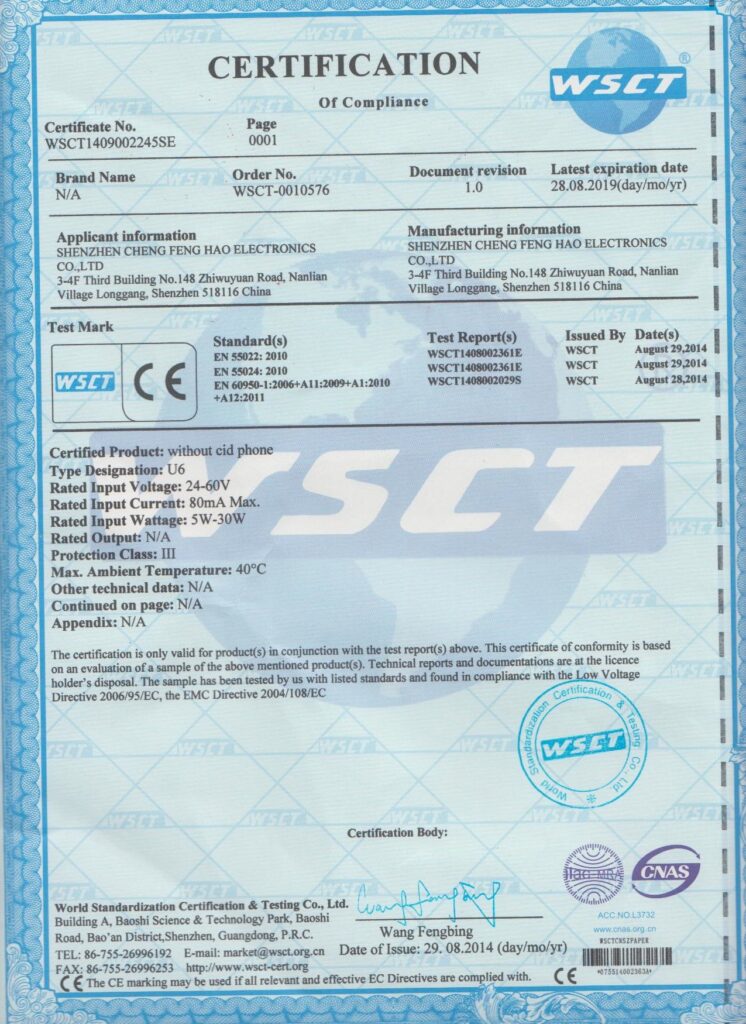
The importer placing the product on the EU market must be able to show a declaration of conformity, keep or obtain the technical documentation, and ensure the product is labelled with the CE mark, the manufacturer’s details and, where required, an importer address in the EU. Harmonised standards (for example the EN 62368-1 safety family, and the relevant EMC and radio standards) are the usual way to demonstrate presumption of conformity, but they have to be the current, applicable ones for that product. From 1 August 2025, additional RED cybersecurity requirements (the EN 18031 series, supporting Commission Delegated Regulation (EU) 2022/30) apply to certain categories of internet-connected radio equipment. A conventional DECT telephone that has no internet connection typically falls outside that delegated act; a connected or app-managed radio product may not. Check the category before you quote EN 18031 as included.
RoHS (Directive 2011/65/EU, with later amendments) restricts substances such as lead, mercury and specific phthalates in electrical products. It is a separate obligation from the CE safety, EMC and radio assessment, even though the CE mark is also used in the RoHS context when the product is in scope. Ask for a RoHS test report or declaration that lists the exact model and materials, not a generic RoHS factory letter.
FCC equipment authorization in the United States
The Federal Communications Commission requires most electronics that can emit radio-frequency energy to follow an equipment-authorization procedure before they are imported and marketed in the US. There are two main routes. Supplier’s Declaration of Conformity (SDoC) is used for many unintentional radiators (a typical wired telephone or a device with only digital circuitry that is not itself a transmitter). The responsible party for SDoC must be located in the United States. Certification, which produces an FCC ID, is used for most intentional radiators — including a DECT 6.0 cordless telephone. The grant is issued to a grantee; the importer should still be able to produce the grant, the labelling and, if asked by Customs or the FCC, the supporting file. See the FCC’s pages on equipment authorization procedures and importation of RF devices (47 CFR 2.1204).
An FCC ID can be checked in the FCC’s public equipment-authorization search. The ID on the nameplate must match the grant and the product. If a supplier offers you a test report with no grant, or an ID that belongs to a different model, stop and resolve it before shipment. Cordless and 4G models also have to use the US frequency plan; a European CE radio file does not substitute for an FCC Certification.
ETL, UL and what a safety listing is for
In the US, electrical safety for many consumer and commercial products is handled through a Nationally Recognized Testing Laboratory (NRTL) listing, not through the FCC. Intertek’s ETL Listed mark and UL’s listing mark are both NRTL marks: they show that the product was tested to an agreed safety standard (often a UL 62368-1 or similar standard, with US national differences). Retailers, insurers and some hospitality groups ask for a listing. Cheng Feng Hao holds ETL certification as a company credential and can discuss product-level listings for a given model. Do not treat an ETL mark as an FCC authorization, and do not treat an FCC ID as a safety listing — you may need both.
UK marking, briefly
Great Britain recognises the UKCA mark and, for many product types, continues to accept CE marking alongside or instead of UKCA, under the current UK product-safety framework (including The Product Safety and Metrology (Amendment) Regulations 2024). Northern Ireland follows a different route in which CE (or CE with UKNI) is required; UKCA alone is not the NI path. Because this area has changed more than once since the UK left the EU, confirm the live guidance on GOV.UK for your product category before you print a carton. Radio equipment still has to meet the applicable UK radio regulations, not only a label design.
What to ask the factory for — a document checklist
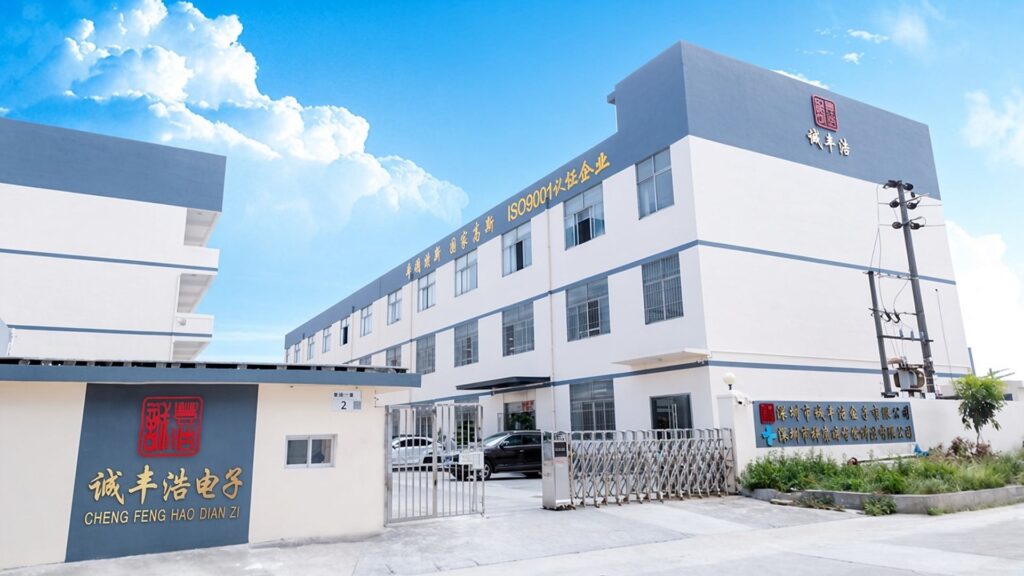
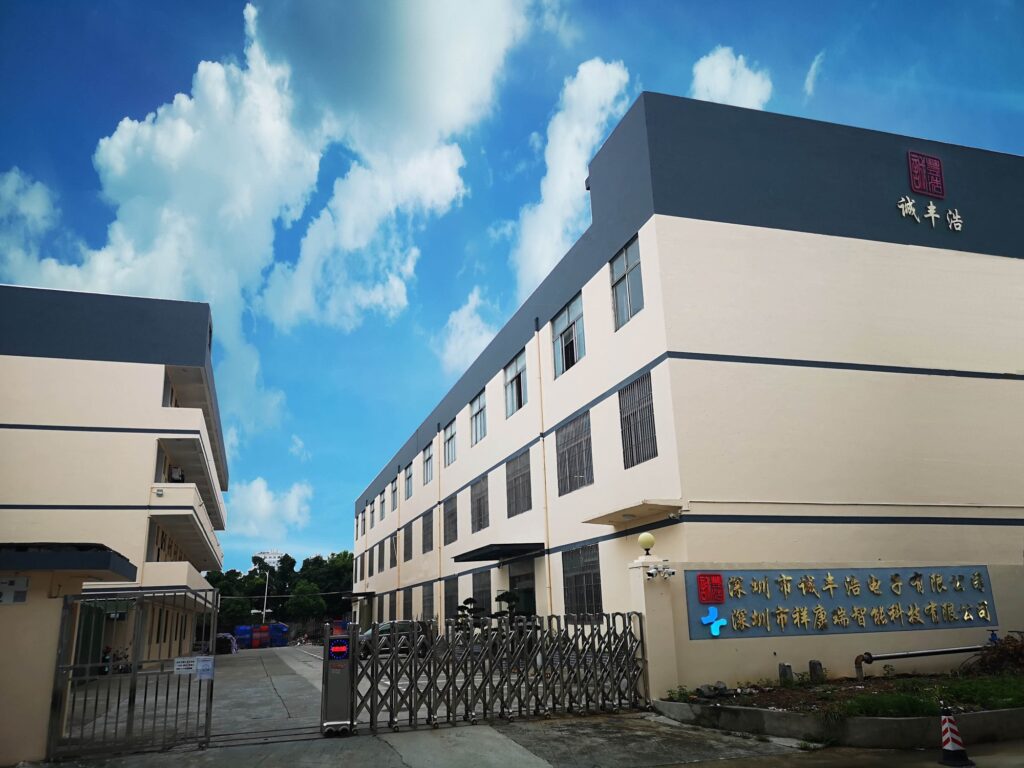
- Legal factory name and address, matching the certificates (for Cheng Feng Hao: Shenzhen Cheng Feng Hao Electronics Co., Ltd, No. 107, Lianxin Road, Longgang District, Shenzhen).
- ISO 9001:2015 and, if relevant, ISO 14001:2015 certificates, and any social audit such as BSCI — useful, but not product approval.
- For the EU: test reports to the applicable LVD, EMC, RED and RoHS standards, a draft EU declaration of conformity, and label and manual artwork showing the CE mark and required details.
- For the US: SDoC package or FCC Certification / FCC ID grant, label placement, and the US responsible-party details where SDoC applies.
- For a safety listing: the ETL or other NRTL report and the exact standard listed.
- A statement that the reports belong to the model and hardware revision you are buying, including the radio version for each destination.
- Packing and nameplate drawings before mass production, so marks are not added as a last-minute sticker that falls off.
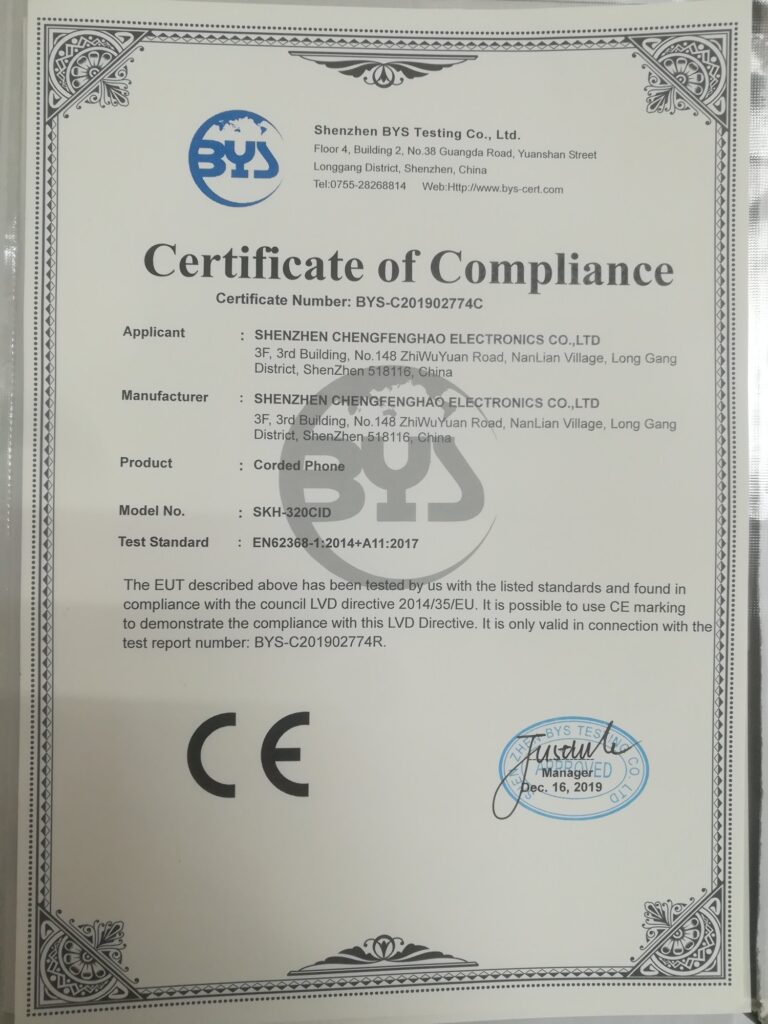
Cheng Feng Hao publishes factory certificates on the Certificates page (including ISO 9001:2015, ISO 14001:2015 and example CE / EMC and LVD test certificates). FCC, RoHS and other market certifications are arranged on request for the destination you specify. That request should be in the first OEM quotation, because testing and potential redesign sit on the critical path.
Practical advice that prevents detained shipments
Do not mix destination SKUs in one master carton if their marks and radios differ. Do not reuse a CE report after a change to the power adapter, the radio module, the antenna or the housing that could affect EMC or safety. Do not print an FCC ID or a CE mark on a box because a previous model had one. And do not ask the factory to add a CE mark without a file: the importer can be the party customs and market-surveillance authorities look for.
Frequently asked questions
Does a CE mark allow me to sell a telephone in the United States?
No. CE is the EU (and, in many cases, Great Britain) conformity mark. The United States requires FCC equipment authorization, and often a separate NRTL safety listing such as ETL. You need the US file even if the product is already CE marked.
Do cordless phones need a different approval from corded phones?
Usually yes. A cordless or cellular telephone is radio equipment. In the EU it is assessed under the Radio Equipment Directive. In the US a DECT 6.0 phone typically needs FCC Certification and an FCC ID, not only an SDoC.
What is the difference between ETL and FCC?
FCC rules address radio-frequency emissions and, for transmitters, radio authorization. ETL (Intertek) is a safety listing from an OSHA-recognised NRTL. They answer different questions. Many US retail programmes want both on a mains-powered or otherwise in-scope product.
Are ISO 9001 and BSCI the same as product certification?
No. ISO 9001:2015 and ISO 14001:2015 are management-system standards. BSCI is a social-compliance audit. They help you judge the factory. They do not legally place a telephone on the EU or US market.
Can Cheng Feng Hao arrange CE, FCC or RoHS tests?
Yes, on request for the destination market you name. The company already holds ISO 9001:2015, ISO 14001:2015, BSCI and ETL. Email sales1@skhelc.com with the model, quantity and countries so the test plan can be included in the quotation.
Tell us the destination market before we quote
If you already know whether you need CE, FCC, ETL, RoHS or a combination, include that in the brief. Cheng Feng Hao is an OEM/ODM telephone manufacturer in Shenzhen. Email sales1@skhelc.com or use the contact form. Factory certificates are on the Certificates page.
Related reading: OEM/ODM manufacturing process · Choosing a DECT cordless phone · About the factory.