
A telephone OEM RFQ is a structured request for quotation that tells a factory what to build, where the set will be sold, how many you need, and what the quotation must include. A short message such as “please quote a cordless phone, 5,000 pcs, with our logo” leaves the manufacturer to guess the radio band, certifications, colour, packaging, accessories and delivery basis — and you will not be able to compare the replies.
Write one specification sheet, number every requirement, and send the same document to every supplier. Mark anything still open as undecided. The goal is a brief that a quoting team can price in one pass.
Key takeaways
- Treat the telephone OEM RFQ and the specification sheet as one package: commercial facts, technical and branding requirements, and a clear list of what the quotation must return.
- State destination countries, first-order quantity and an honest annual estimate separately. Quantity and market drive tooling, testing, packaging and unit price.
- Name the product type and a reference model if you have one. A DECT cordless phone, a hotel phone and a SIP desk phone are quoted from different platforms and different compliance lists.
- Ask for a compliance matrix, price breaks, tooling and testing charges, sample cost, and when any quoted lead time starts. Cheng Feng Hao’s published MOQ is 3,000 pcs per model (500 pcs for the TC-001 and TC-002 tablet phones).
What a telephone OEM RFQ should achieve
An RFQ is not a casual catalogue enquiry and it is not a full request for proposal. Use it when you already know the kind of telephone you need and want comparable prices, exceptions and lead-time statements. If you are still choosing between private-labelling an existing platform and funding a new design, read our guide to the OEM versus ODM telephone manufacturing process first, then issue the RFQ.
Three habits make replies usable:
- One document, sent identically. If each factory answers a different question set, the comparison is already broken.
- Numbered requirements. Numbered lines get numbered answers. A quotation that references your numbering is much easier to audit.
- Fixed, flexible or undecided. A false decision made to fill a blank often has to be unmade later. “Undecided between A and B; please quote the cost difference” is useful information. A blank field is not.
Cheng Feng Hao (brand CFH) is a telephone manufacturer in Shenzhen, founded in 2003, with the factory established in 2010. The team includes 250+ employees and 10 product engineers in a 30,000 m² production area. Custom logo, colours, packaging and display language are available on OEM and ODM orders.
Write the commercial header first
Destination, quantity and delivery basis change the bill of materials, the test plan, the carton and the unit price. Put them on the first page of the specification sheet before you list features.
- Buyer and project. Company name, technical and purchasing contacts, project name, and a revision date so later emails do not mix versions.
- Destination countries and sales channel. Retail, hotel, office, care or a brand’s own label imply different packaging, languages and marks.
- Quantities. Give the first firm order, then an annual estimate labelled as an estimate. Ask for price breaks at quantities you might actually release — do not inflate a forecast only to obtain a lower sample price.
- Samples. State how many evaluation samples you need and what you will use them for (appearance, line or PABX/SIP testing, packing review).
- Delivery basis and currency. Name the Incoterms® 2020 rule you want quoted (for example EXW, FOB or CIF) and the currency. A unit price without a delivery basis is not comparable.
If you have a target cost band, say so and say what it includes. Ask the factory to quote your baseline and to list cheaper or more expensive alternatives separately, rather than silently substituting a component.

Build the specification sheet around the product type
“Telephone” is not a specification. The platform decides the tool, the radio or network interface, the accessories and the certification path. Name the type, attach a reference model or short feature list, and say what must be copied, improved or left to the factory.
| Product type | Specify at least |
|---|---|
| DECT cordless | Frequency band (EU DECT or DECT 6.0), handset count, answering machine, adapters, and why two SKUs are required if you sell in both regions. |
| Corded / caller ID or basic phone | Display, caller-ID type, speakerphone, memories, PABX flash timing, wall-mount and colour. |
| Hotel guest room phone | Guest service keys and faceplates, message-waiting lamp, mount, colour and PABX compatibility. See the hotel phone buying guide. |
| Big button / care | Key size and contrast, amplification, hearing-aid compatibility and SOS. See the big button phone for care homes. |
| SIP / IP desk phone | SIP accounts, PoE, display, keys, codecs and provisioning. See the SIP desk phone buying guide. |
| 4G fixed wireless | Bands, SIM or eSIM, backup battery, and any DECT handset. See 4G fixed wireless phone vs landline. |
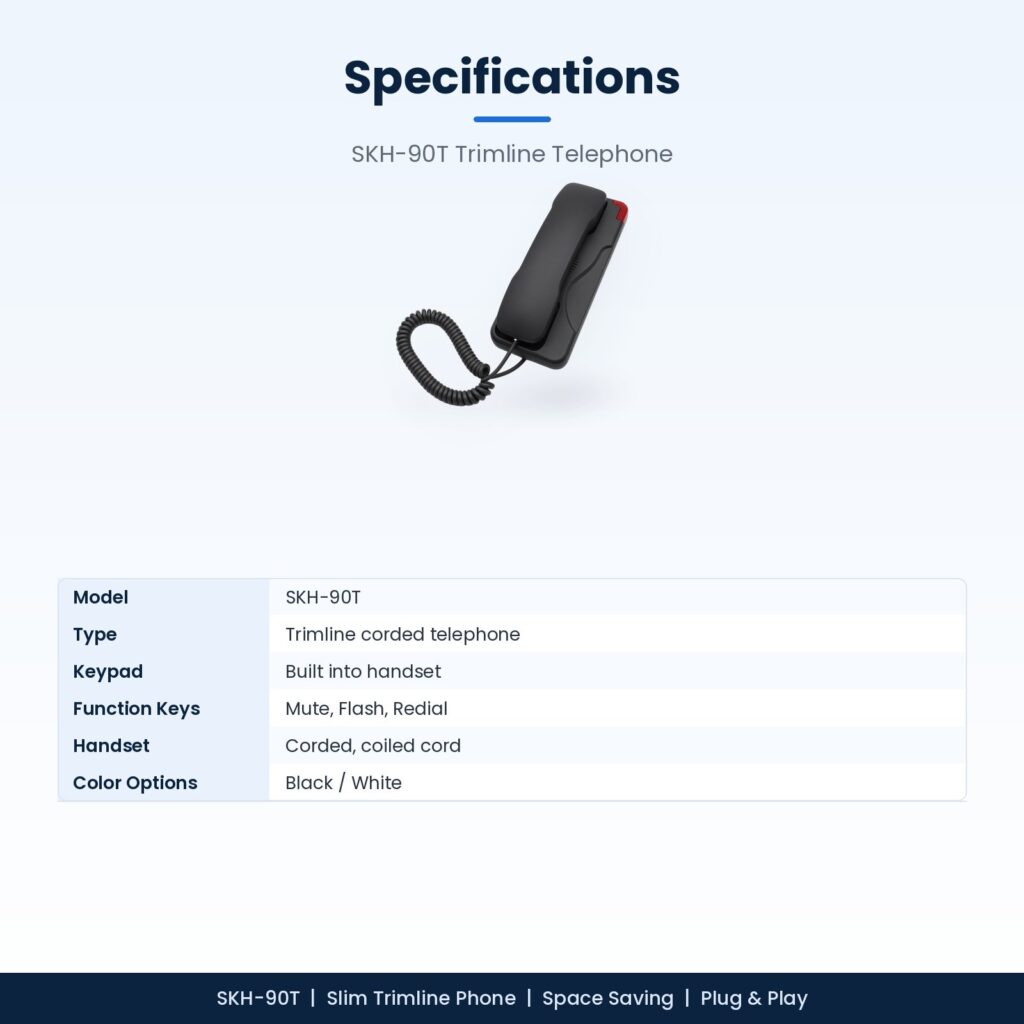
A published specification graphic is a starting point, not a complete RFQ. The SKH-90T listing, for example, identifies a trim-line corded telephone with a keypad in the handset, mute, flash and redial, and black or white colour options. The RFQ still has to add markets, quantities, logo, packaging, certifications and the quotation format you want back.
Features, colours, firmware and tooling
Once the type is fixed, list the functions that change the board, the tooling or the firmware: display language, caller ID, speakerphone, memories, volume, headset port, flash times, or — for cordless and SIP sets — registration and provisioning. If a feature is optional, ask for it as a priced alternative.
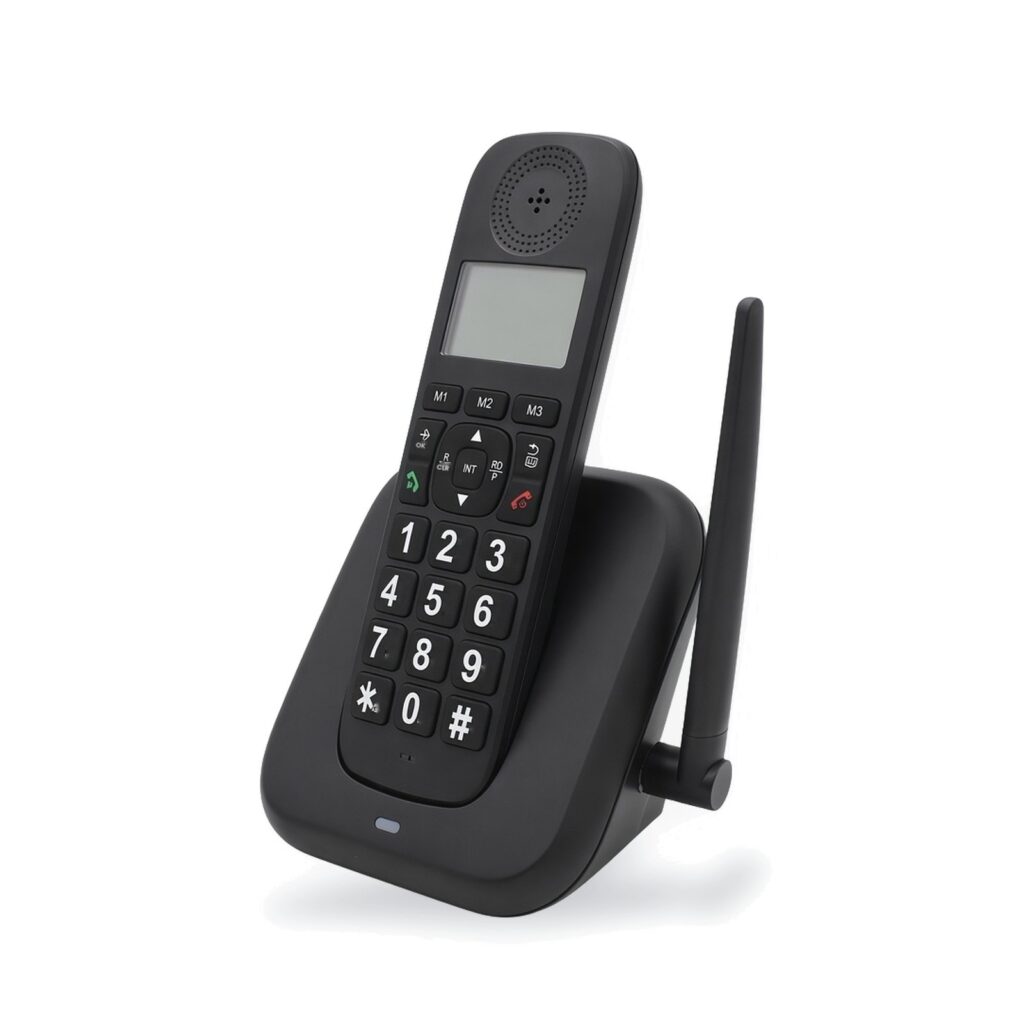
For appearance, give colour references, logo placement and the number of colourways — each extra colour is its own run. State whether you are labelling an existing housing or commissioning a new mould. A new tool has a non-recurring charge and a longer path to first articles; ask who will own the tool and how spare parts will be handled. Do not ask a factory to copy a third-party design you do not have the right to use.
Specify branding, packaging and in-box accessories
“Standard export packing” is not a specification. Packaging changes unit cost, print minimums and carton volume. Custom logo, colours, packaging and display language are available on CFH OEM and ODM orders; the RFQ still has to say what you want.
- Logo artwork status and where it appears on the product and the box.
- Unit packaging: retail box, gift box, polybag or bulk, plus box and manual language.
- Barcodes, batch or date codes, and marks on the inner box and master carton.
- In-box accessories: cords, market-specific adapters, batteries, hotel faceplates or wall brackets.
- Whether a carton drawing or packed sample must be approved before mass production.
List certifications, test reports and quality checks
The destination market decides the marks, not the factory’s general approvals. A cordless or 4G product sold in the European Union follows a different path from a corded set sold in the United States. Ask for the documents that apply to your SKU and say whether you will use existing test reports or need a new test plan. See our guide to telephone certifications for importers and the certificates page.
Keep system certificates and product certificates separate. Cheng Feng Hao holds ISO 9001:2015, ISO 14001:2015, BSCI and ETL. Those describe the factory’s management systems and, for ETL, a product-safety mark; they do not mean every SKU is already certified for every market. FCC and RoHS documentation can be arranged on request — say so in the RFQ.
For outgoing quality, name the inspection standard you want — for example a pre-shipment inspection against an agreed AQL — and whether you will send a third-party inspector. If first-article approval is required, say how many units and who signs them off.
Tell the factory exactly what the quotation must include
A complete telephone OEM RFQ still fails if each supplier returns a different kind of number. Ask for the same breakdown from everyone, and a complies / exception / does not comply line against each numbered requirement.
| Quotation line | Ask the factory to state |
|---|---|
| Unit price | Price at each quantity break, currency and Incoterms® 2020 rule. |
| Tooling / NRE | Whether a new mould is required, the charge, and who owns the tool. |
| Testing and marks | Reports already available, plus any extra testing charge and scope. |
| Samples | Sample price, whether it is creditable, and sample preparation time. |
| Lead time | Production lead time and the event that starts the clock (deposit, artwork or sample sign-off). |
| Warranty and spares | Warranty period and how defective units or spare parts are handled. |
| Validity | How long the quotation remains valid, plus any material or FX caveat. |
Do not treat a quoted lead time as a calendar date until you know what starts it. Artwork approval, colour matching and a new tool often sit in front of the production window. If payment terms matter, ask the factory to propose them.
Telephone OEM RFQ section checklist
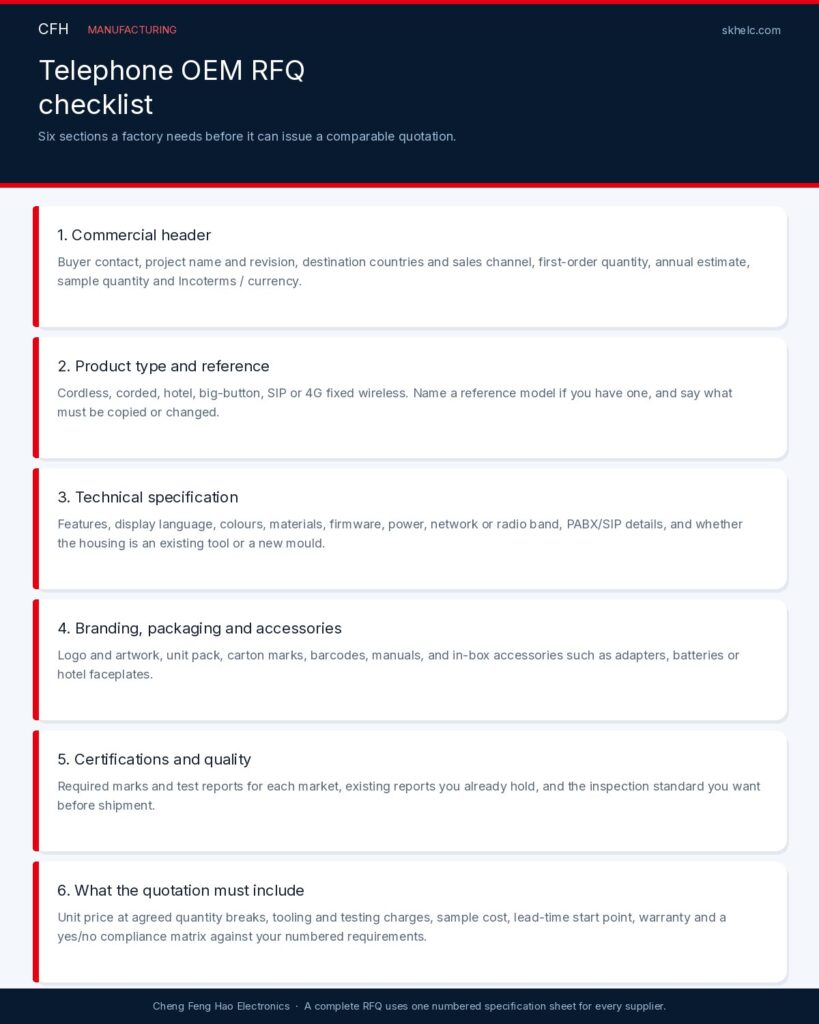
Use the table below as the spine of the specification sheet. A structured email, a spreadsheet or a short PDF all work; completeness and a single revision number matter more than the format.
| Section | Include | Why it matters |
|---|---|---|
| Commercial header | Contacts, revision, countries, channel, quantities, samples, Incoterms, currency. | Sets price, testing and packing. |
| Product type | Platform, reference model, what to copy or change. | Selects the tool and compliance path. |
| Technical spec | Features, languages, colours, firmware, power or radio, existing or new tool. | Drives components, NRE and firmware. |
| Branding and pack | Logo, unit pack, cartons, barcodes, manuals, accessories. | Changes cost, MOQ and volume. |
| Compliance and QA | Required marks, existing reports, inspection and first-article rules. | Avoids a requote after the price is agreed. |
| Quote format | Price breaks, NRE, testing, samples, lead-time start, warranty, validity, matrix. | Makes replies comparable. |
How to send the RFQ and compare the replies
Send the identical package, give a realistic reply deadline, and name one technical contact. Compare replies on the compliance matrix first, then on the breakdown — not on a single unit price. A lower number that excludes testing, a colour box or a new tool is not a saving.
Order evaluation samples from the shortlisted factory and test them as the product will be used: on the target PABX or SIP platform, in the destination frequency band, and in the intended packaging. Then convert the RFQ into a purchase order against the agreed revision.
If you would like Cheng Feng Hao to quote, send the destination countries, product type, reference model or feature list, quantity and required certifications to sales1@skhelc.com or use the contact form. You can also start from the product shop or the Alibaba store. We will confirm matching CFH platforms and reply within 24 hours during office hours.
Frequently asked questions
What is a telephone OEM RFQ?
A telephone OEM RFQ is a request for quotation sent to a manufacturer that has, or can tool, a telephone platform you want to private-label or customise. It combines a commercial header (markets, quantities, delivery basis) with a specification sheet and a list of the prices and documents you want returned.
What should be included in an RFQ for a custom telephone?
Include destination countries, first-order and estimated annual quantities, the product type and reference model, features, colours, firmware or display language, packaging and accessories, required certifications, and the quotation breakdown (unit price, tooling, testing, samples, lead-time start point and warranty). Number each requirement and mark open items as undecided.
What is the difference between an RFQ and a specification sheet?
The specification sheet describes the product — type, functions, appearance, packaging and compliance. The RFQ is the request that wraps around it: who is asking, how many, on what delivery terms, and what the factory must return. In practice they travel as one package.
What is the minimum order quantity for OEM telephones from Cheng Feng Hao?
The published MOQ is 3,000 pcs per model, or 500 pcs for the TC-001 and TC-002 tablet phones. Custom logo, colours, packaging and display language are available. Send destination countries, product type and quantity to sales1@skhelc.com.
Do I need a new mould for a custom telephone?
Not always. Many OEM programmes start from an existing housing and change the logo, colour, faceplate, firmware or packaging. A new mould is needed when the enclosure itself must change. Ask whether your brief can use an existing tool and, if not, to quote tooling ownership and first-article timing separately.
Should I send the same RFQ to more than one factory?
Yes, if you want a comparison. Send the identical specification and quotation format to each supplier, then compare the compliance matrix and the cost breakdown rather than a single unit price. Evaluate samples from the shortlisted factory before placing a production order.
Request a telephone OEM quotation
If you are preparing a telephone OEM RFQ or a specification sheet, send the destination countries, product type, required features and estimated quantity to sales1@skhelc.com or use the contact form. Our product engineers will confirm matching CFH platforms and reply within 24 hours during office hours.